SewMona

A slice of my Florida life

  • Sewing
    • SewMona on Etsy
    • Clothes
      • Boys
      • Girls
      • Men
      • Women
    • Pattern Reviews
    • How to Sew
  • Camping
    • Florida Campgrounds
  • Recipes
  • Crafts
  • DIY
  • About

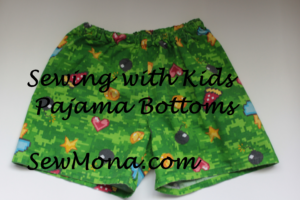
Sewing with Kids – Making Pajama Shorts Plus A Free Pattern

Walk the Plank Pajama Bottoms

*This post contains affiliate links.

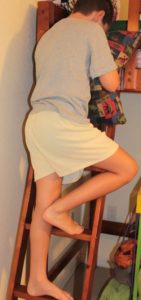
I made the mistake of taking my youngest son with me to JoAnn’s one day (I’m sure he went along because we always stop at Starbucks afterwards!).  He found some woven (non-stretch) material that he really liked.  I had no clue what we would make with it, but I bought a yard for him.

He told me he wanted to make a sheath for his sword.  Boys! (picture a mom eye roll) I suggested that we could also make some pajama shorts for him and that maybe he could even help with the process – I would cut them out and then he could sew the two pieces together and then I would do the waist and hemming (I’m sure kids can hem, but my 10 y/o isn’t ready for that yet).
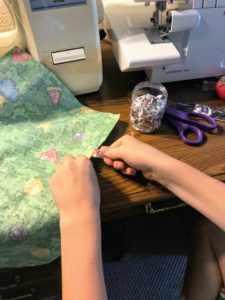
Sewing PJ Pants with kids

I knew that the Walk the Plank PJ Pants by Patterns for Pirates would be perfect and it’s free – no code, no joining a Facebook group, just hop on over and “buy” it.
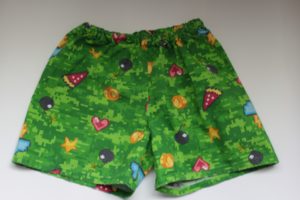
Walk the Plank jammie shorts

I made his somewhere between short and knee length.  The short shorts I made for him previously were too short for him and the knee length were just too long to be comfy for sleeping.
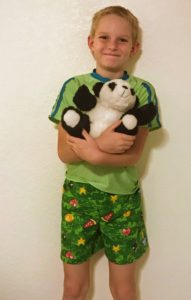
Finished PJ Pants

He was so proud of himself!  Using Mom’s machine for the first time, learning to use clips instead of pins (which are so hard for kids!), and the final result is wearable.  That’s a win in my book!
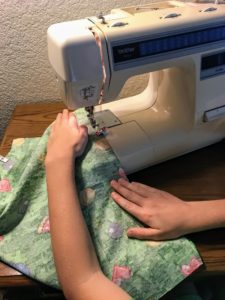
Sewing PJ Pants with kids

For reference, here’s the short shorts length on him.  I feel like just a couple extra inches made a huge difference in how comfortable they are for sleeping and lounging.
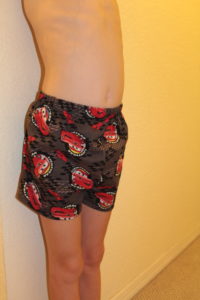
Even though the directions don’t call for it, I sewed around the top of the waistband too – just about 1/4″ from the fold.  I think it adds a more finished look to the waist.
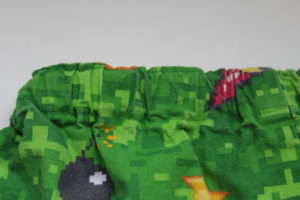
Waistband detail

I also made some Walk the Planks for my other two kids.  Besides short shorts and knee length, it also comes in pants length (or you can be like me – have them try them on before hemming and choose your length).   Both of these are knee length.
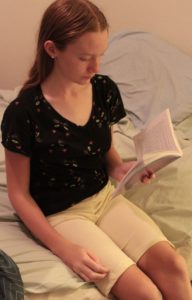
There’s also an adult version (I have not made this version) which is also free and includes men’s and women’s sizes.  You could make family pajama pants!

*This post contains affiliate links.  See my disclosure policy for more details.
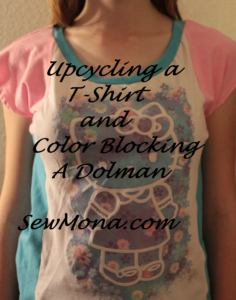
Upcycling a T-Shirt and Color Blocking a Dolman

Finished Dolman Upcycle Color Block

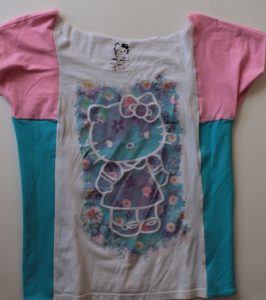
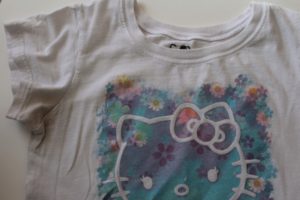
My daughter got this shirt for her birthday year or two ago and loved it!  However, it has recently gotten a little tight and she was sad about the thought of it going to the rummage sale.

Original too small shirt to be upcycled

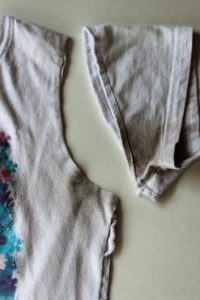
I told her I might be able to upcycle it into a “new” shirt.  She was agreeable and I decided that a dolman was my best option (OK, actually I was going to do a raglan, but I would’ve had to reprint the pattern…foster kittens got to it….the dolman pattern was all printed and ready to go).  The first step is to cut the sleeves off (and throw them away!) and cut the side seams and shoulder seams.  I cut as close to the seams as possible.  You should end up with a front piece and a back piece.

First cut off the sleeves, upcycle

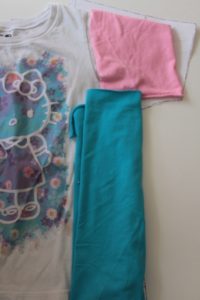
To make the dolman work, I would have to color block.  Color blocking is not my strong suit!  I have a hard time seeing what the finished thing will look like.  I tried laying out the fabric on the pattern so I could get an idea of what it would look like.

Laying Out color blocking

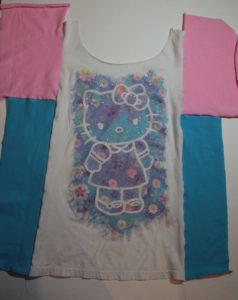
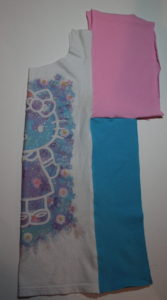
While doing this, I realized that I needed to straighten out the sides to the shirt and the arm cutouts to make it more like a panel, so I trimmed it down some.  Once I was happy with they way it looked, I sewed my pieces together.  First I sewed a pink rectangle to a blue rectangle.  I also hemmed the bottom of the blue since I was keeping the original t-shirt hem.  Then I sewed it to the newly straightened out sides of the the old t-shirt.  I also decided I was going to need to redo the neckline, so I cut the neckband off.

T-Shirt Color Blocked

Then, I folded my piece of fabric in half and put it on the pattern and trimmed it to fit.

Attach the color blocking

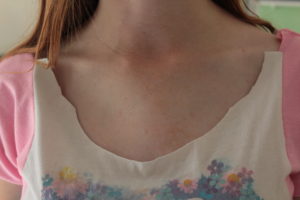
Then, I sewed the side seams.  At this point, I was really worried about the neckline.  It looked really wide for my very modest teen!  I was hopeful that the new neckband would pull it in!

Dolman upcycled t-shirt

I had her try it on and I was still worried.  It just seemed overly big!

Dolman neckline too big, upcycled t-shirt, color blocking

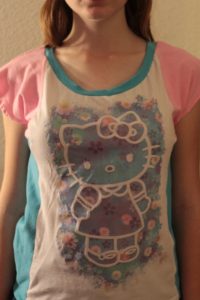
I figured at this point, I might as well finish it. All I had left was the neckband and hemming the sleeves.  I’m actually pretty happy with the way it turned out!

Finished upcycled color blocked dolman

I probably could’ve made the neckband smaller, but it works as is too.

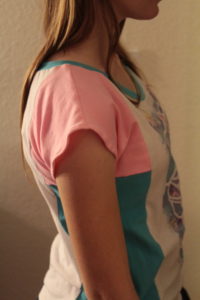
Side view finished color blocked upcycled dolman

Do you upcycle your kids clothes?  Do you color block?

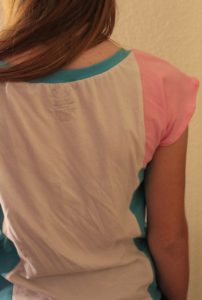
Back finished upcycled color blocking dolman

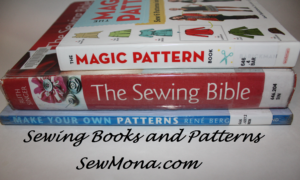
Sewing Books and Patterns

 Sewing Books and Patterns
*This post contain affiliate links.

If you follow me on Instagram, then you know I recently discovered sewing books.  I don’t know why it never occurred to me to look for sewing books, but….  I’ve read four so far (having a real job really cuts into my reading time!).  I’m including the Amazon links to my favorite three books, but I found them at my local library in the non fiction section in the 646 section.  Make sure to see what other books are there – I need to remember to check out that section at one of my local libraries (I have two close to me).

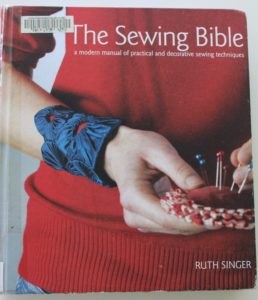
So far, my three favorite sewing books are The Magic Pattern by Amy Barickman, Make Your Own Patterns by Rene Bergh, and The Sewing Bible by Ruth Singer.  All three of these books teach you about sewing and patterns and then have some projects for you to try.

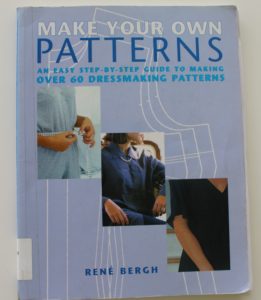
Make Your Own Patterns 

This book details how to design and/or alter patterns that are custom fit for you (or your spouse or your child or whomever you choose).  If you are interested in designing your own patterns or altering existing ones, this is the book for you.  It includes all the measurements you need to draft or modify a well fitting pattern.  Bodices, necklines, sleeves, blouses/tops, jackets, skirts, dresses, and trousers are all covered.  There are also basic quarter size patterns that you can enlarge and then customize to your size and style using either their ideas or your own.


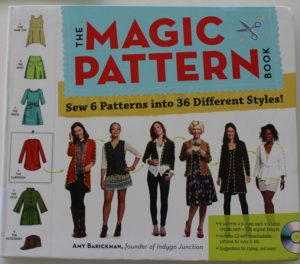
The Magic Pattern

This book comes with a CD with the patterns from the book.  The idea of making six different items from one pattern is intriguing.  In theory, you could make an entire wardrobe with just these patterns (and the book gives you suggestions for taking the patterns from one season to the next).  The six patterns are a tank top, skirt, dress, cardigan, coat, and accessory (hat).  Add your favorite pair of shorts, jeans, and/or leggings and you’re all set.  I did find the list of tools you will need to get started to be a little bit excessive.  My list of sewing tools you need to get started includes only the basics.  I do like the description of different kinds of fabric you can use.  Printing these patterns is very much like PDF patterns that you can buy – print the pattern, measure the test square, and then fit the pieces together.  There is good information on adjusting the pattern and finishing techniques.


The Sewing Bible

This book has so much information about all kinds of sewing techniques!  You can learn about hand sewing and machine sewing in this book.  There are so many hand sewing stitches.  Several that I’ve never heard of and did you know you can sew buttonholes by hand?  Yikes!  Might be OK for just one, but I can’t imagine trying to make several all look the same!  Plus, I’ve made friends with my button hole maker on my sewing machine.  You can learn quilting basics, different seam types, different ways to install a zipper as well as other fasteners.  There are so many different kinds of seams!  You can learn about shirring and smocking.  After you’ve learned the practical and decorative techniques, there are projects you can do.  This book is a great reference guide for both beginners and advanced sewers (sew-ers).

What’s your favorite sewing book?

*This post contains affiliate links.  See my disclosure policy for more details.
How To Sew – Making A Dolman Plus Get A Free Pattern

*This post contains affiliate links.

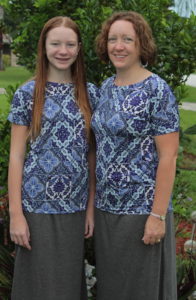
MotherDaughterDolmans

I was so excited because I really wanted to do a dolman style shirt for the next easy pattern and I recently discovered a free one!  You have to join the Facebook group to get the code for it.   The wide range of sizes (00-26) is another reason I like this pattern – I can make shirts for my daughter and me from the same pattern.  She’s a teenager and sometimes she fits kids sizes and sometimes she doesn’t.

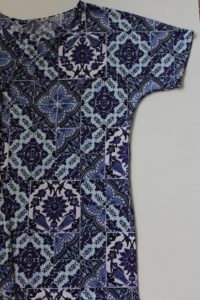
Dolman Slim Fit

Dolmans are really easy because there are no sleeves to sew in since they are part of the body (although there are options to add long sleeves to it).  Two seams, a neck band, sleeve hems, and the bottom hem.  This pattern is also for knits so you’ll need a ball point needle.  Either a size 14 or 11 (The thinner the material the smaller needle number).

Halla Slim Fit Dolman

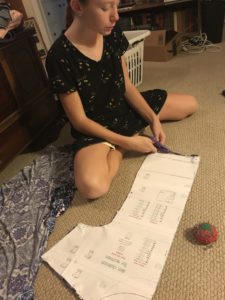
I decided to have my daughter make one of these with me – just to show how easy it is.  Her least favorite part is pinning and cutting and yes, we’re on the floor…not ideal, but it works in a pinch.

Learning to cut out a pattern

Just to keep things real – she didn’t actually get to sew her shirt.  My machine was giving her fits – skipping stitches.  It turned out that I was using the wrong size needle and then the needle was bent just the slightest bit.  By the time I realized that, she was done.  Since I don’t want to force her to sew, I finished up her shirt.

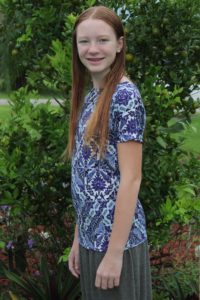
Even though this pattern is free, there are still options!  Don’t like the slim fit?  You can make it less fitted.  Want bat wing style sleeves?  You can do that too.  The best part is, these are techniques that you can use to alter other patterns you have.  There are two neckline options.  For my daughter, I did the higher neckline and for mine, I went with the lower neckline – still perfectly modest, just not as high.  I tried on the shirt before I put the neckband on and was concerned that the neck was going to be too big.  Never fear, once the neckband was on, it fit perfectly!

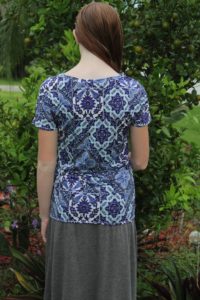
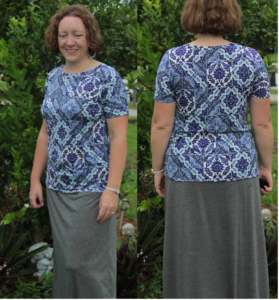
Halla Slim Fit Dolman Front and Back

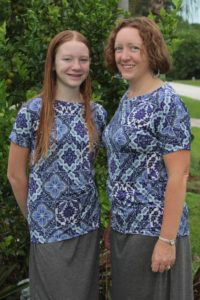
The dolman pairs perfectly with the Chloe maxi skirt (also free and super easy) from Made for Mermaids (which is what we’re wearing in our matching pictures).  I’m sure that at some point in the future, my teenager won’t want to match me, but for now she loves it.

Halla Slim Fit Dolman and Made for Mermaids Chloe

The Hallå Slim Fit Dolman is available for women in sizes 00-26.  Join their facebook group to get the code to get it free (read the pinned post).


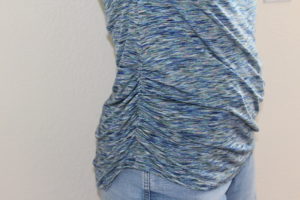
Another option for a dolman pattern is the Sun Kissed Tee dolman by Peek-a-Boo Pattern Shop.  It is NOT free, however she does have sales on occasion.  It’s a simple no frills pattern, but there’s an option to add ruching to the sides which is why I love the pattern!  I think the ruching adds a nice touch and it’s really not that hard.  There are others with more sleeve and hem options, but for beginners, I really like these two.

Dolman shirt with ruched sides.

*This post contains affiliate links.  See my disclosure policy for more details.
How to Sew – Making a Pillow

I’m going to assume here that you have very little sewing experience.  If you need a reminder of the basics of sewing, this post is for you.  If you want to teach your kids to sew, this post might be for you.  If you’re looking for my next post with a pattern recommendation – this is not the post.  Sorry, I thought maybe I should go over some basics first.

I’m not actually making a pillow; I’m just recovering one.  Maybe you have a well loved pillow that could use a new lease on its life.

The easy part is ripping off the old pillow cover.  Then you need about 3/4 yard of fabric.  Depending on how wide it is and how big/small your pillow is, you might be able to get away with 1/2 yard.  If you want to make a new pillow, you’ll need a bag of stuffing too. If your pillow is really flat, you can fold it in half to make it fluffier.

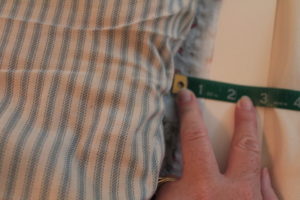
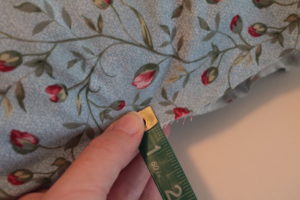
Lay your pillow out on your fabric.  Leave an inch border to allow for the seam allowance (1/2″) and a little for the puffiness of the side.

Fold the fabric over the top of the pillow and match up the edges.  Make sure that they meet with 1/2″ leftover for the seam.  Cut any extra fabric off.  You should now have a rectangle of fabric that fits nicely over your pillow.
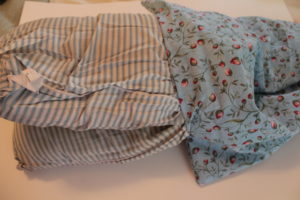
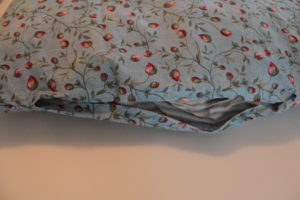
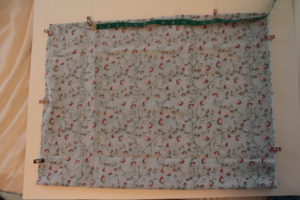
Put the pillow to the side.  Fold your fabric in half right sides together (side note – Most of the time when you’re sewing two pieces together, you’ll do it with the right sides together.  Then when you turn it right side out, you won’t see the seams).  Pin or clip the sides together.  Leave an opening on one side so you can replace the pillow.  I like to leave it in the middle of a seam.  It needs to be about 2/3 of the opening – big enough that you don’t have to fight to get the pillow back in.

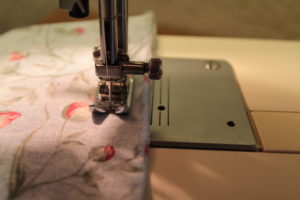
Now you’re going to sew the sides together using a 1/2″ seam allowance.  My sewing machine has markings for different seam allowances.  I measure from my needle to the lines to figure out which one was 1/2″.  Then I make sure the edge of my fabric stays on that line.

Use Marks on Your Machine for Seam Allowance

When I get to a corner, I sew to what I think is close enough so that when I turn the corner, my edge is lined up with the line.  Make sure the needle is down and lift the presser foot.

Sewing Turn Corner

Turn your material and see if the edge lines up with your line.

Turn the corner

In this case, it didn’t, so I turn the material back and sew another stitch or two.

Seam isn't sewn quite far enough

Turn it again and this time it does line up.  Make sure to put the presser foot back down.  It’s just about impossible to sew with it up!  Finish sewing your edges together remembering to leave your opening for stuffing.

Sew another stitch then turn the corner

Every time you start or end a seam, you need to go backwards a couple stitches and then forward a couple.  So, when you start, you sew a couple stitches, then push your reverse button and go back a couple, then go forward and finish your seam.  When you reach the end (not a corner, but the very end of the seam), back up a couple stitches and go forward again.

Back stitch at the beginning and end of each seam

Make sure you trim your thread ends too.

Don't forget to clip your thread ends

Turn the pillow cover right side out.

Finished pillow cover

Then comes the fun part – stuffing the pillow in.  Depending on how large or small you made the opening, it may be easier or harder.  I tend to make them as small as I can….  I folded my pillow in half to make it easier to stuff.  Once I get it in the case, I can unfold it and make it lay right.

Stuff the pillow into the case

One last step – closing up the opening.  There are two choices – hand sew or machine sew.  If you’re making a fancy pillow, you probably want to hand sew it since it’s easier to hide your stitches.  I despise hand sewing and avoid it at all costs!  On a side note, I do enjoy counted cross stitch…go figure.  So, I’m going to sew this shut on my machine using thread that’s as close to matching the fabric as possible.  Turn the edges to the inside.

Fold seam to the inside

Then clip it closed.

Clip the seam together

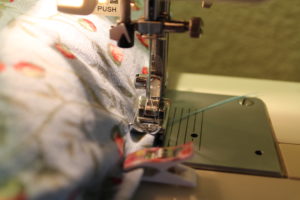
It can be hard to get a pillow up close enough to your machine to sew, but to me it’s worth it to not hand sew!  This time, I want a very narrow seam, so the edge of my seam is just under the edge of the presser foot.  Go slow and make sure your seam stays together.  There’s nothing more frustrating than thinking you’re done and realizing that the bottom part slid out and didn’t get caught in the seam!

Carefully sew the opening closed

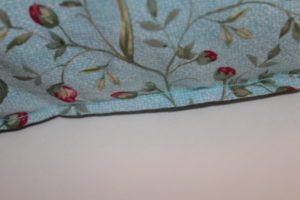
The seam will look similar to this.The finished seam

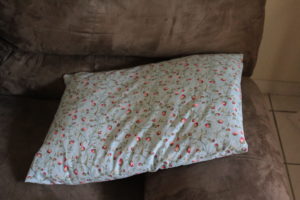
Admire your new pillow.Your new pillow is ready for use

  • 1
  • 2
  • 3
  • 4
  • Next Page »

Hi, I'm Mona - wife, mom, teacher, seamstress, blogger. This is my home on the web. Read More…

Categories

Copyright © 2026 · The Marianne Theme By Blogelina · Built on the Genesis Framework

Copyright © 2026 · The Marianne on Genesis Framework · WordPress · Log in