SewMona

A slice of my Florida life

  • Sewing
    • SewMona on Etsy
    • Clothes
      • Boys
      • Girls
      • Men
      • Women
    • Pattern Reviews
    • How to Sew
  • Camping
    • Florida Campgrounds
  • Recipes
  • Crafts
  • DIY
  • About

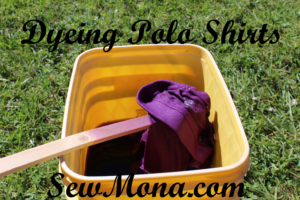
Dyeing Polo Shirts

Dyeing Polo Shirts

I’ve had two light colored polo shirts that were stained, but I hated to throw them away because they were pretty new (as in they got stained on one of the first wearings).  I washed them, rewashed them, treated the stains, retreated the stains, washed them some more, but nothing worked.  So, they’ve been sitting on my sewing desk waiting for me to figure out what to do with them.  Then, I wondered about dyeing them.  I chose purple because it’s darker and I’m hoping that it will cover the stains.  For about $2, it’s a pretty cheap way to remake a shirt!
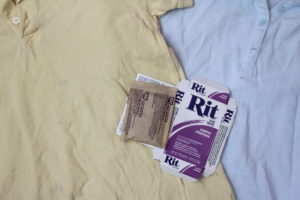
All you need is a box of dye and some shirts.

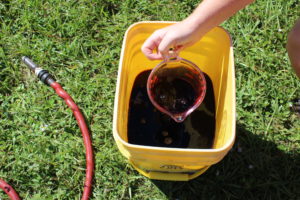
I opted to dye them in a bucket (an old kitty litter pail).  I filled it about half way with hot water and added some hose water.  Although the directions said to add 3 gallons, I didn’t measure.  The only thing I did measure was the hot water to mix the dye.

MixTheDye

AddTheDye

I heated water on the stove, soaked the shirts and then added the whole mix to the dye.
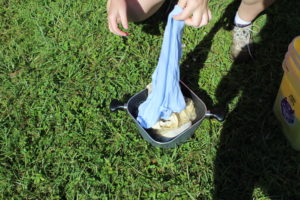
WetThePolos

When I dunked it in and then lifted it right back out I wasn’t sure I was going to like it.
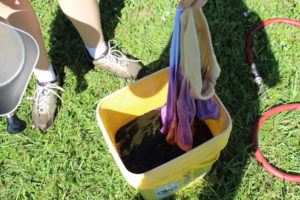
AddPolosToDye

About 20 minutes later when I checked it and the color was so much better!
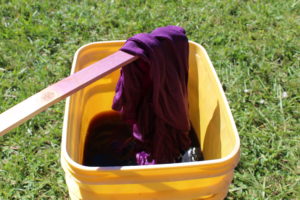
Checking the dye color.

After about 25 minutes, I was happy with the color.  I dumped my dye and then rinsed the shirts in clean water.  I kept rinsing until the water was clear.  Then I hung it over a chair to drip dry.  When it stopped dripping, I tossed it in the dryer…then I re-read the directions and saw that I was supposed to wash it first.  Oh well.  I’ll just wash it separately for the first couple times.
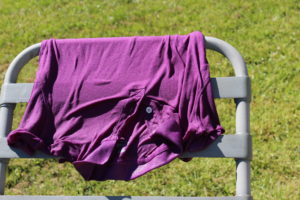
DryingDyedPolos

So, because I didn’t wash it right after I made it, I washed the dyed polo shirts with our towels.  I don’t care so much if the towels come out with a purple tint.  Although the the water did get a little purple, my towels were OK.  I’ll probably continue to wash them with towels until they don’t make the water purple though.  Better safe than sorry!
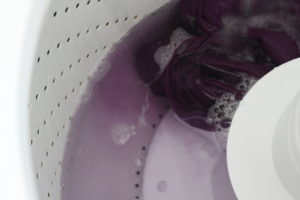
Washing a dyed shirt

The dye covered the stains pretty decently, but not the thread.
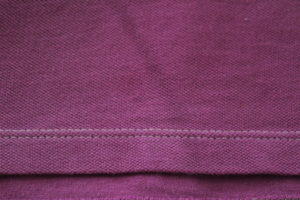
The dye didn't cover the stitching.

It did make slightly darker spots where the stains were, but I don’t think they’re very noticeable.  Definitely not as noticeable as the stains before I dyed the shirts.
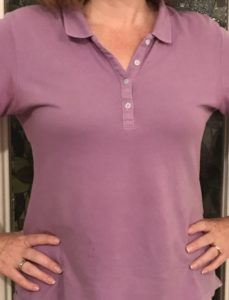
Finished Dyed Shirt

Have you ever dyed anything?  Did it work out?
Why Paper Patterns


Why Paper Patterns

A couple weeks ago I posted my top 5 reasons to use PDF patterns.  However, there are also some really good reasons to use paper patterns.  Here are my top 5 reasons to use paper patterns.

  1. Cheaper – This is a big one!  JoAnns regularly has patterns for $.99.  You can’t beat that price.  Even if you have to buy more than one to get all the sizes you need, it’s still a great deal!  Even WalMart sells patterns.
  2. Perfect for personal use – If you aren’t selling what you make, then paper patterns make perfect sense.
  3. No printer, ink, or paper required – Paying for ink and paper can be expensive!  Having patterns printed at a copy/print shop can save your printer ink, but it’s still going to cost you.  Paper patterns avoid this.
  4. Easier to store – I don’t know about anyone else, but I have a terrible time storing my PDF patterns.  Once they’re taped together, there’s no easy way to store them.  Paper patterns are fairly easy to fold up and put back into the envelope they came in.
  5. One stop shopping – you can look through three or four different designer catalogs at one store.


I think they can be summed up into one word – convenience.

What about you – do you prefer paper patterns or PDF patterns?  Why?

Learning to Sew and Pattern Review: Chloe & Women’s Chloe

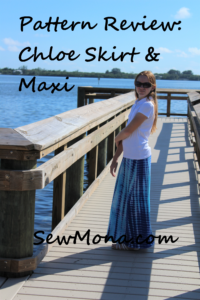
Chloe Skirt and Maxi Pattern Review

This post contains affiliate links.

Learning to sew doesn’t mean you have to make pillowcases or pillows or other items you don’t really need or want.  You can learn to sew and make something wearable and fashionable at the same time!  Are you looking for an easy pattern to learn to sew?  Or maybe you want to teach one of your kids to sew?  Are you looking for a cheap (aka free) pattern? Keep reading to see how to get an awesome deal on this trendy pattern.

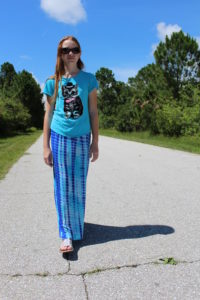
I was recently able to test the Chloe and Women’s Chloe patterns by Made for Mermaids.  These are simple A-line skirts with yoga style waistbands and a choice of short or maxi length.  No elastic to mess with – just four seams.  When I saw how easy they were, I knew that it was the perfect pattern for my daughter to learn how to use my machine.  Normally she sews on her machine.

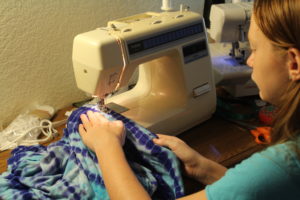
Kid Sewing, Chloe Skirt

This time though, she was able to use my machine (which has a stretch stitch) to sew herself a knit maxi.  Two long straight seams (the sides), one short straight seam (the waistband), and one seam to attach the waistband (I did help with that – stretching and sewing takes some practice although I’m sure with some guidance she could’ve done it herself).  I also did the hem – a rolled hem on my serger.

Chloe Skirt, Sewing with Kids

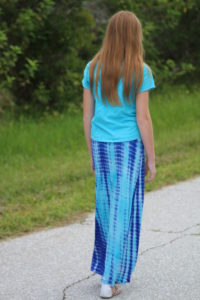
Maxis are everywhere now and they are so comfy!

Maxi Chloe

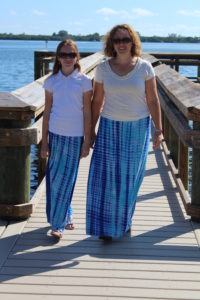
We don’t do the matching thing very much, but with something this easy & this comfy how could we not?

Matching Chloes

Matching Chloes

Short Chloe, Grace Top

Short version of the Chloe and the Grace top.

Maxis are perfect for summer weather – lightweight knits make a cool and breezy skirt while still being modest even if you’re chasing after kids!

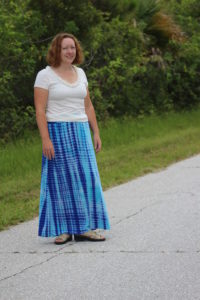
Women's Chloe maxi skirt

My version of the Women’s Chloe

Both of these patterns are free – no codes needed, no joing a Facebook group, just follow the links and “buy” the patterns!  Then come back and show me what you made.

This post contains affiliate links.  For more information see my disclosure policy.

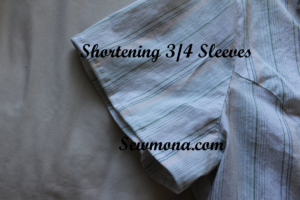
How To Sew: Shortening 3/4 Sleeves

How to sew shorten sleeves

I’m working on a series of posts about adjusting clothing to fit.  To see all of them click here – How to Sew.

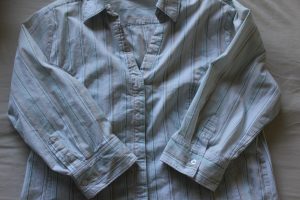
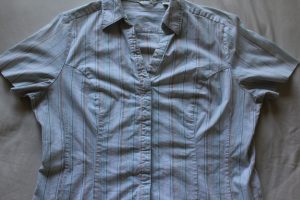
I’ve had this shirt for several years now.  I really like it, but I’ve only worn it a handful of times.  Why?  It has 3/4 length sleeves with a button cuff.  I’m not sure who thought that would be comfortable, but it isn’t!  The sleeve can’t slide up and down my arm.  No matter how I move my arm, the sleeve stays right there – half way between my elbow and my wrist.  It means the rest of the shirt pulls up whenever I reach.  I’m not into showing off my midriff and it’s just plain uncomfortable.  So, it mostly sits in my closet.  Why have I kept it?  Well, I do like the style & the print.  It’s also nice material with 3% spandex so it has a little give to it.

Button Up Shirt with 3/4 Length Sleeves

The other day, I wanted to wear it, but as soon as I put it on, I remembered why I don’t.

Button Cuff Doesn't Let Sleeve Slide

The sleeve can’t slide past my elbow. Very annoying!

Plus, now that I live in Florida, I don’t have much need for anything beyond short sleeves.  I’m not sure why I didn’t think of it sooner – I’ve shortened a lot of hubby’s dress shirt sleeves.  It’s so easy!

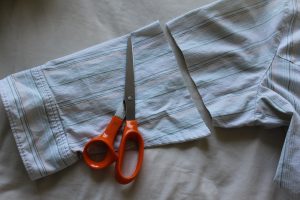
Cut the sleeve off at the desired length plus 1/2″ for the hem.Cut Sleeve Off

Using the cut-off as a pattern, cut the other sleeve to match.Cut Other Sleeve to Match

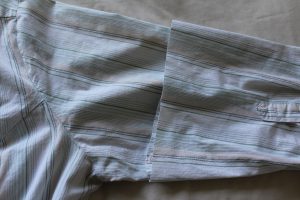
It looks better already!Sleeves Shortened

All they need is a quick hem.

Turn under 1/4" on the sleeve edge.

Turn under 1/4″ on the sleeve edge.


Turn under another 1/4" and sew in place.

Turn under another 1/4″ and sew in place.


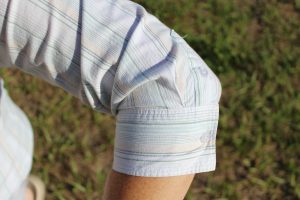
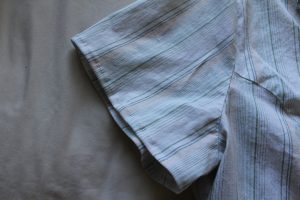
Finished Sleeve

My new short sleeved shirt.

My new short sleeved shirt. (and yes, I purposely told my daughter to not get my face).

Don’t forget to take the buttons off the cuffs before you toss them.  You can never have too many extra buttons!

How To Sew: Taking in Elastic Waist Pants (or Capris or Shorts)

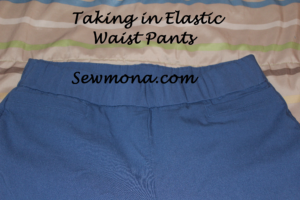
TakingInElasticWaistPants

I’m working on a series of posts about adjusting clothing to fit.  To see all of them click here – How to Sew.

My mom recently gave me a pair of capris that didn’t fit her real well (apparently they did until they met the dryer).  She thought they might fit me.  They are a nice slightly stretchy pair of blue capris.  They fit me perfectly except for the waist – it was just slightly too big and gaped in all the wrong places – not good for a kindergarten teacher who needs to be able to move around.

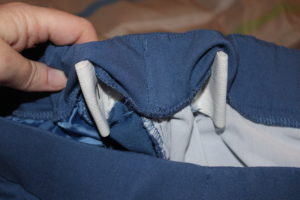
To fix an elastic waist, you need to open up the seam, cut the elastic, resew it, and then close up the seam.  Easy enough, right?  First, look at the waistband to see how the elastic is put in.  On this pair, the elastic is sewn to the capris at the sides.

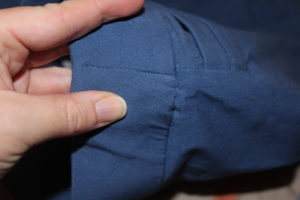
See the stitching between my fingers? That’s tacking the elastic down. It helps make sure the stretch is even and helps the elastic not to fold in half.

See the stitching between my fingers? That’s tacking the elastic down. It helps make sure the stretch is even and helps the elastic not to fold in half.

To get to the elastic, you will need to remove some of the waistband stitches.  Because the elastic is tacked down at the sides and because I don’t want to rip out the stitches through the elastic, I’ll rip open a small piece on each side of the side seam.  If your elastic isn’t tacked down, you’ll only need one opening.

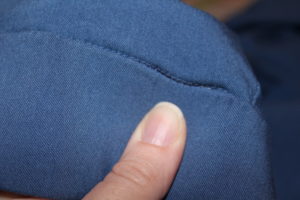
Stitch in the Ditch

This is the stitching you will need to remove.

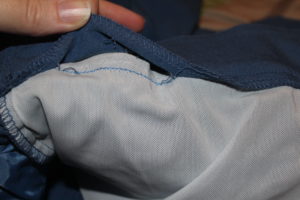
The opening only needs to be about 2 inches – enough to pull the elastic out and tighten it.

Seam Opening

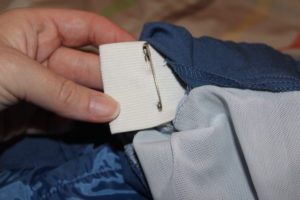
Pull the elastic out through the openings and pin it to the desired tightness.  Make sure to tighten the front and back equally if the elastic is tacked down.  Try them on to be sure they fit.

Pinned Elastic

Double check that you’ve tightened the elastic evenly in the front and back if it’s tacked at the sides.

Make sure elastic is pinned evenly

Make sure the elastic is pinned evenly in front and back.

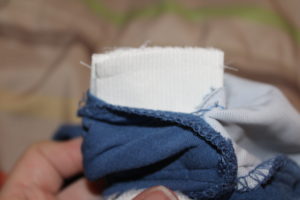
Once you’ve tried them on and are sure you like the fit, sew the elastic together where you pinned it.  Use a ball point needle and either a stretch stitch (I use a triple stretch stitch) or a zigzag to avoid having a tangle of thread.  Trim the extra elastic close to your stitching – leave about 1/4″.

Trim elastic close to the seam

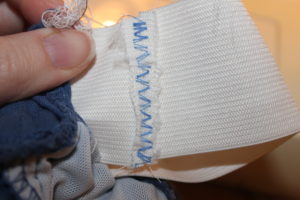
Spread the seam flat and using a wide zigzag stitch, sew it down.  This will prevent a bulky place in the waistband.

Zigzag seam flat to prevent a bulky spot in the waist

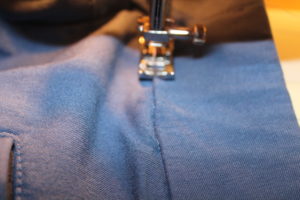
Tuck the elastic back in the waistband and fold the fabric back down.  Carefully sew it back down.  In this case, I did what is called stitch in the ditch.  I sewed in the seam made when the waistband was attached to the capris.  This stitching is barely visible when finished.  You do need to take your time doing it so that it looks neat when you’re done.

Stitch in the ditch to close up the openings.

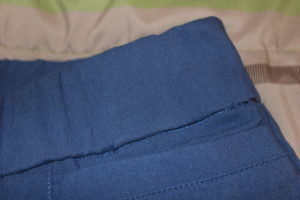
The finished stitch in the ditch doesn’t show much.

Finished stitch in the ditch barely shows.

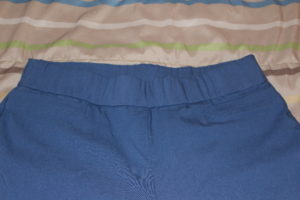
Finished capris – the elastic is evenly stretched between the front and back.

Stitch in the ditch all finished

  • « Previous Page
  • 1
  • 2
  • 3
  • Next Page »

Hi, I'm Mona - wife, mom, teacher, seamstress, blogger. This is my home on the web. Read More…

Categories

Copyright © 2026 · The Marianne Theme By Blogelina · Built on the Genesis Framework

Copyright © 2026 · The Marianne on Genesis Framework · WordPress · Log in